For modern, personalized coding today
Practical Experience Hybrid Codability
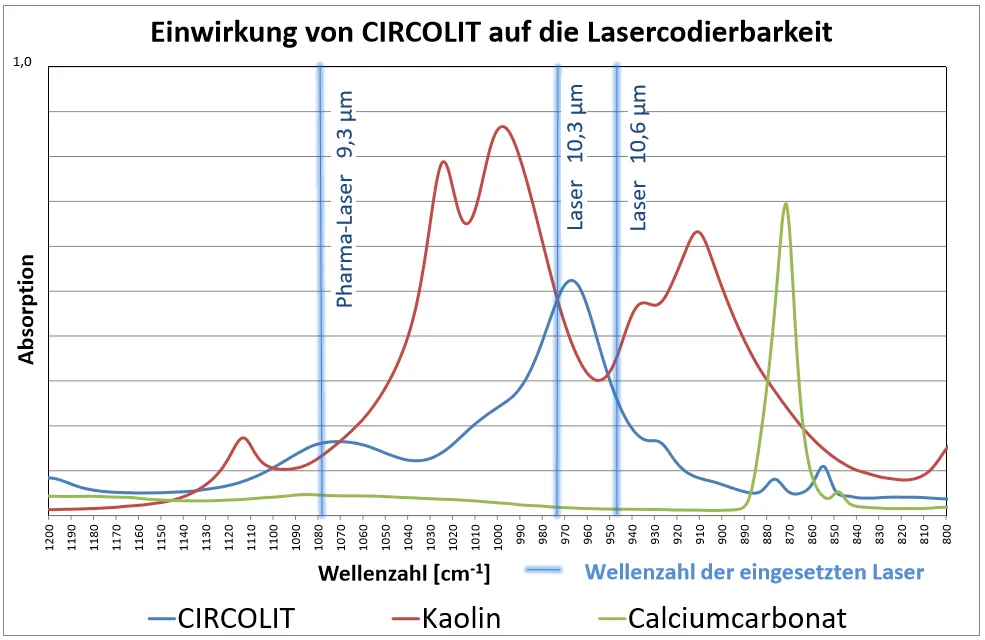
By incorporating just one pigment ~ specifically 10 parts CIRCOLIT®-Slurry into the topcoat formulation- to a standard calcium carbonate formulation, simultaneous laser and inkjet codability can be achieved.
From CIRCOLIT®-slurry, like kaolin, leads to good ablation in laser printing, but is also beneficial for inkjet codability, kaolin can therefore be completely omitted. With the addition of just one pigment, namely CIRCOLIT®-slurry, allows for the creation of two functionalities (laser and inkjet codability).
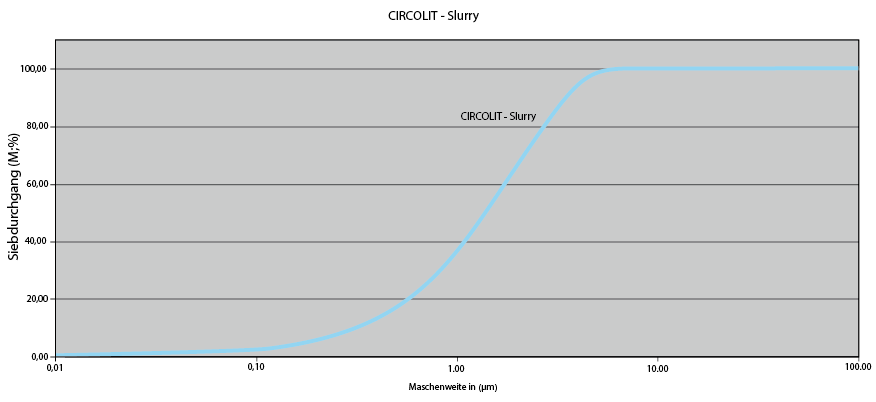
The switch to 90 parts GCC (fineness 90/95% < 2 µm) and 10 parts CIRCOLIT®-slurry often leads to a reduction in binder demand compared to standard formulations with higher kaolin content – the optimized binder quantities must be determined and depend on various factors in coating rheology, pre-coated board, and the application unit. It is frequently reported that even with a slightly reduced coat weight, the inkjet and laser codability functionality is maintained.
In terms of handling and runnability, the use of CIRCOLIT proves to be®-slurry is very unproblematic – a significantly reduced tendency for so-called blade and doctor blade streaks is often praised compared to operation without CIRCOLIT®-slurry.
Another functionality of CIRCOLIT is®-slurry exhibits exceptionally good performance in coating opacity, which is why this pigment is often used as an opacifying pigment in the pre-coat, especially in the GD board sector.
Machine changeovers demonstrate the high performance of CIRCOLIT®-slurry and interesting cost-effectiveness.
Inkjet Marking
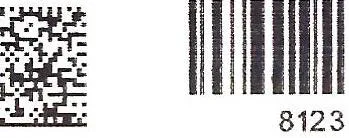
Printing DataMatrix codes on pharmaceutical folding cartons is typically done using drop-on-demand (DoD) printers.
The quality of inkjet coding primarily depends on the line quality. The most common error occurring shortly after printing is the smudging of the DataMatrix code.
Therefore, the smudge resistance of the cardboard is evaluated after very short periods. The cardboard sample is printed and, after a precisely defined time, is precisely counter-wiped against a wiping unit. The print is then verified offline using a verifier according to DIN EN ISO/IEC 15415. The following criteria are examined in more detail: symbol encoding, symbol contrast, axial non-uniformity, grid non-uniformity, error correction according to ECC200, modulation, and pattern defects.
Even 10% CIRCOLIT®-slurry in the top coat, when used with commercially available inkjet marking devices, leads to sufficient smudge resistance and the fulfillment of the required criteria.
The high absorption volume and fast uptake kinetics are also evident in other applications, such as coated grades for high-speed inkjet.